ASK REAL ESTATE
How to Make Your Landlord Enforce the Noise Rules
Buildings have rules. New York has laws. But sometimes, it's best to start with a friendly conversation.
By Jill Terreri Ramos
January 10, 2026
NYT subscribers can click here to read this article on the NYT Site
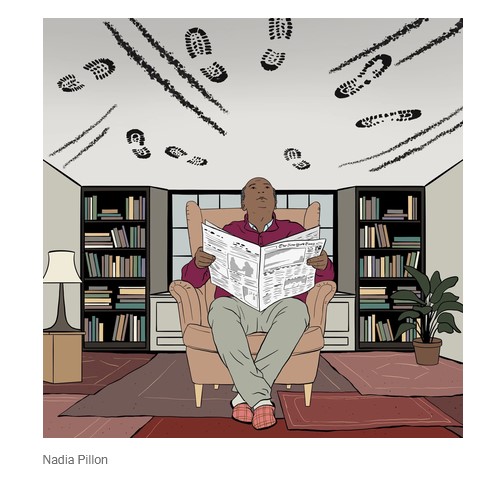
Q: I live in a rent-stabilized apartment in Manhattan, and the neighbor above me is in constant motion. Starting as early as 6:30 a.m. and going as late as 10:30 p.m., we hear heavy footsteps going back and forth, moving furniture, banging, and something that sounds like a loud machine. His apartment has been updated, with the old hardwoods replaced with laminates that look like hardwood. I've heard about an ordinance that requires carpets or rugs on 80 percent of bare floor spaces. Is that right? What should we do?
A: New York City tenants have a right to a habitable apartment. There are laws and building policies that could help you deal with excessive noise.
First, look at your lease. Does it include rules about quiet hours or "nuisance behavior?" These should be enforced. Many buildings also require that 80 percent of the floors are covered by carpeting, though that is not a city ordinance.
The noise you hear, like heavy stomping, may be exacerbated by inadequate soundproofing that's been incorrectly installed, said Alan Fierstein, a noise consultant and owner of Acoustilog Inc., in Manhattan. Carpeting would quiet the sound of small objects that land on the floor, but not heavy footsteps, he said.
The city's noise code does prohibit unreasonable noise, though professional testing to prove your case - that is, how loud and how often the noise is happening - is expensive.
You could politely tell your neighbor that the noise is impacting your life and ask him to make changes to prevent it, even during certain hours. A loud machine with a fan or a filter could benefit from thick carpet or pad underneath, Mr. Fierstein said.
"If that fails, it is up to the landlord to enforce the terms of the lease by requiring the noisy tenant to install carpeting or area rugs and observe quiet hours," said David A. Kaminsky, who practices real estate law in Manhattan.
To spur your landlord to act, send a letter by certified mail with a return receipt, stating that you cannot live peacefully in your apartment because of unreasonable noise, and request that noise testing be done. You can remind the landlord about the warranty of habitability, a state law that protects tenants against "conditions which would be dangerous, hazardous or detrimental to their life, health or safety," as well as any relevant provisions in your lease.
 ®
®